Thursday, February 14, 2008

February 2008 - Things Are Happening; Make Haste!

The media has been broadcasting all sorts of depressing news having to do with real estate and the economy overall. Foreclosures and short sales are all too common in many markets around the nation - Detroit, Cleveland, Florida, the west coast, the east coast... they're all struggling. Right?

All of the newspapers, including the New York Times this morning, have made reference to the "housing correction".

"What a bad time for real estate", some people have said to me. "You must be wishing you were still in consulting!" others have shared.

I'm busy. Things are happening. I'm really busy! And its not just me.

I helped a client negotiate a contract over the weekend in a multiple bid situation. Multiple bid?! What is this, 2004?!? People are looking for well-priced homes in their price range, and when they find them, they're buying them.

I have thirty-one active housing searches for buyers running right now. Some buyers have more than one, and some aren't looking aggressively, and may not even buy, but thirty-one!?! That's more than a few people looking for homes.

And it isn't just me. My office is teeming with activity. People are taking new listings, people are selling homes. People are buying homes.

February, March, and April are great times to be transacting real estate, and this year is no exception. There is latent demand from November and December, during the holiday season when no one wants to shop for a home. There are New Year's resolutions, spring cleaning, and "it's time to sell" fever.

Mortgage rates are incredibly low, and that makes a difference. A 30-year conforming loan can be had for less than 6% at the time of this article. 5-year ARMs and 7-year ARMs are making a resurgence, because they now present a spread that makes sense. 5 1/8% on a 5-year ARM, wow!
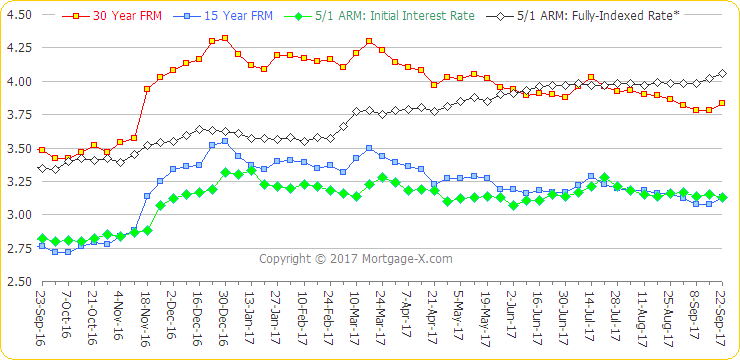
Copyright © 2008 Mortgage-X.com
Source: www.mortgage-x.com
Reprinted with permission


The President signed the economic stimulus package into law yesterday, providing a tax rebate to American individuals and families. The law also changes the definition of conforming loan limits, which will help consumers in parts of the country to get larger loans at conforming loan rates (currently .75 to 1% lower than Jumbo loan rates). This may not have an impact on Chicago-area home buyers as the law is currently written.

What does this mean for the economy for this year? According to the WSJ, Benjamin Bernanke says that his
“baseline” forecast is for the economy to experience “sluggish” growth for the next several months but to regain some speed later in the year.
What about us Chicagoans and our real estate market?

The future is not 100% clear, of course, but I can tell you that things are looking pretty good from where I stand. Home buyers are out there, in droves, and they are looking for nice homes, but they are also looking for good deals. There is still a lot of inventory, so buyers can afford to be choosy, but there's also a great deal of over-pricing. There has never been a more important time to price your home correctly and competitively. With the depth of the current inventory and the buzz of home buyers, a well-priced home can sell very quickly, while an over priced home is almost sure to collect dust.

Home buyers are wondering why some homes have such long market times, and are steering clear. They are swarming to newly listed and freshly marketed places.

If you want to sell your home, don't wait until summer. Summer and winter are traditionally slow in Chicago. The mortgage rate future is unclear. The market conditions are unclear. What is clear is that things are happening now, and they're happening fast.

Wednesday, October 31, 2007

Three Important Reasons to Buy Your Home Now

You remember me telling you last fall that there may never be a better time to buy real estate in the City of Chicago. Of course I hedged a little - I didn't say there wouldn't be a better time, I merely said that their may not be a better time to buy. I stand by what I said then, the market was primed for purchase, deals were to be had, and rates were low. Prices have held steady.

There are three main reasons that now is such a prime (maybe an ever better) opportunity to buy a home in Chicago.
  1. Inventory is very high. There are so many homes to choose from. If you cannot find a home that suits your style and fits your budget in the current environment, you need to determine if you're being realistic in your search.

  2. Homes have continued to hold their value, but prices have not grown as quickly as they have historically.

  3. Interest rates are still incredibly low, within a point or so of their 40-year low for a 30 year fixed mortgage.
As it relates to inventory, in September 2007 there was almost 13% more inventory in those same 5 key neighborhoods than there was in September 2005. What's more, in that same timeframe, the number of sold properties decreased by over 30%. The ratio of listed-to-sold decreased from 18% to 11%, or a 39% drop, when comparing September '07 to September '05. There are more places on the market and the rate of sales has slowed, that causes serious sellers to work harder to sell their home. For a buyer that means seeing homes in better, more marketable conditions, priced more appropriately, and sellers who may be more willing to negotiate or offer some sort of concessions.

As it relates to home values, the Illinois Association of Realtors reports that

According to IAR’s latest report, the Illinois median home sale price in September was $200,000, up 0.8 percent from $198,500 in September 2006. The statewide average home sale price in September was $264,749, up 4.6 percent from $253,139 a year ago. There were 10,476 total home sales in September 2007, 22.9 percent below September 2006 which logged 13,594 home sales. Year-to-date, sales were down 15.4 percent to 112,278 homes sold January through September 2007 compared to 132,784 homes sold during the same period last year.

“Most Illinois homeowners are experiencing very healthy long-term gains in the value of their homes, and real estate remains the single best investment over the long term providing wealth accumulation especially for those who keep the home for a typical holding period of six to 10 years,” said REALTOR Kay Wirth, president of the Illinois Association of REALTORS. “Market basics are solid and with low mortgage interest rates, strong household formation and job creationmoving forward these factors should bode well for a recovery in the housing economy.”

You can read the full release here.

Despite poor housing news on the National headlines, home prices in the same key 5 neighborhoods have continued to rise modestly in that time by just over 6% (~3% annually)! That means you are buying in a period of modest growth (as opposed to rapid), without fear that you could have paid less for a comparable home in the future, and with confidence that the value of your investment is appreciating.


Finally, we come to interest rates. The national news has reported loudly on the demise of the mortgage industry due to the Subprime Mortgage "crisis". "Not so fast my friend," as a popular sportscaster likes to say, while this has had an impact on the national housing market and could impact many prospective home buyer's ability to get a mortgage, it doesn't have to affect you.

I have seen no issues (correct - none) with qualified home buyers getting a pre-approval for a mortgage. Gone are the days when a borrower with less than stellar credit can get 100% financing with no documentation - and for good reason. However, if you can make a strong down payment 10-20%, or have strong credit, or have a good income and a low debt to income ratio, (at least some combination therein) you will be able to find a good loan deal with a reputable lender. It is more important than ever to work with an experienced lender that closes a majority of their deals in your locality (read: does business predominantly in Chicago). If you don't have a trusted lender, your licensed Realtor can certainly recommend two or more who have done a good job for their clients in the past.

Mortgage rates are currently incredibly low. In the last 40 years, we've seen them bottom out about 1 point below their current price. What's more, 30 year fixed rates are sitting a couple points below the current prime rate. That is a historical rarity rivaled by solar eclipses.

Copyright © 2007 Mortgage-X.com
Source: www.mortgage-x.com
Reprinted with permission

Have you heard the expression "buy low and sell high"? If you've read my blog you have. Actually, if you haven't been living in a cave you have...

Your purchase will put a roof over your head and a place to keep your stuff. It will give you many years of enjoyment. It should also appreciate in value over time.

If you want to buy low - now is the time. The price of homes is relatively low (and I don't see them declining) and the price of money (i.e. mortgage rates) is historically very low. There's plenty to choose from, so you are in the driver's seat.

If you have a home to sell, you may be thinking that the "buy low, sell high" is working against you. On the contrary, if you are moving up, buying a more valuable home, you should sell your old home now (for less) in order to get the great value home now, while prices are high. Its like selling 100 shares of a lower priced stock to buy 200 shares of a more valuable stock right before the market takes off.

Saturday, July 07, 2007

The Hidden Costs of Selling Your Own Home

So you've decided to sell your home. You're moving into something bigger, or you need a yard and a den for the impending little one, or a third bedroom for the second child. Maybe you're moving closer to family or relocating for a new job.

Should you hire a Realtor? How hard can it be to sell a house?

You're a smart and business savvy person. You've sold your own cars in the past. You sold your old bike and your stereo on Craigslist. You know you need a sign, you'll have to put an ad in the newspaper, and then you'll have to answer the phone and show your home. Why pay a Realtor a 5-7% (let's call it 6%) commission? I mean, that's a lot of money!

The reality is that selling your home is much more complicated than that. What's more, you don't actually keep that 6% that you were weighing against the effort required. It costs money to sell your home, pure and simple, and if you're going to spend that money, use it to hire a professional. You cannot afford not to.

Why does it cost money to sell a home? Where are those costs you've overlooked?

  • Co-operating commission - This is the commission or "finder's fee" paid to an broker/real estate agent who brings the selling party a buyer. If you are not willing to pay a co-op commission, you will have a hard time finding a Realtor eager to bring you a buyer. The vast majority of home buyers are now represented by an agent, according to a recent RealtyTimes article, so you've just eliminated most of the buyer population if you insist on not paying a co-op commission. [Incidentally, I've yet to meet a For Sale By Owner (FSBO) who refused to pay one.]

    In 2006, 12% of all home sellers sold "by owner", according to NAR. Almost half of those sold their home to someone they already knew. That leaves about 7% of FSBOs who sold to a stranger. If the majority of those buyers are represented by an agent, that means out of 1000 home sellers, about 25 are avoiding a commission altogether.

    A typical co-op commission in Chicago is about 2.5% (some higher, some lower). Either you pay that, or your Realtor does, if you've hired one. That takes your cost of hiring a Realtor down to 3.5% not the original 6% we'd estimated.

  • Reduced Sales Price - That's right, you will (statistically speaking) sell your home for less money when selling by yourself than when you hire a professional Realtor. According to NAR:
    Homes sold with the help of a real estate professional in 2006 sold on average for 32 percent more than FSBO sales. The median FSBO selling price in 2006 was $187,200, compared with $247,000 for agent-assisted transaction

    Now I don't claim that a Realtor will get you 32% more money for your home than you can get yourself. Maybe its the case that there are more people are willing to try to sell their lower priced home than there are mansion-owners who attempt to "go it alone". That said, we're looking at $187,000 versus $250,000 in home price - that isn't the difference between Gilligan and Thurston Howell in most towns. Let's generously assign 2/3 of that discrepancy to other factors (not agent expertise). That still leaves us with 10% higher sales price for a Realtor than without one.

    Why would that be? Well, a Realtor sells homes for a living, they do this every day. They study the market daily. They have been in half the homes on your block. They know what you're competing with, and what all the neighbor's homes sold for and when. They know how to stage a home to make it most desirable for home buyers. Why? They've sold a lot more homes than you have. They know which features to promote, and how, and where. And, maybe most importantly, they know how to negotiate the sale of a home. They can remove emotion from the equation, they can quote statistics and empirical evidence, and they know how to find those extra dollars.

    Where does that put our 3.5% commission now? You've just cost yourself 6.5% of your home's value by not hiring a professional. Your 6% commission is now -6.5%. We don't need to continue, but we can...

  • Marketing costs - How will your new buyer find you? Will you go on the MLS? If you do, (though you're not technically a FSBO now), you're paying someone a flat rate. I've seen companies that will do this for as cheap as $450, and you can pay as much as you want (I've seen over $1000). This is weighed against your savings of course. What about ads in the paper? What about marketing on all the big websites (the vast majority of home buyers conduct their search online now)? You can post to Craigslist for free - again and again every week - though I've had only moderate success on Craigslist. As an agent, I take advantage of all these marketing vehicles at no extra cost to the seller. How about pictures? Will you take a dozen snaps with your digital camera? I'll hire a professional photographer, and they'll look great. Don't forget to go buy that generic "For Sale" sign for the front yard. Does that scream "this is a deal!" or what? Your agent has a fancy, classy sign for your front yard.

    How will you spread your message? I share all of my listings with literally hundreds of real estate agents, all of whom have buyers in your neighborhood. I email hundreds more local residents with my newsletter featuring your home. And then I mail out full color postcards to "move up" buyers, and those postcards feature those professional photos. Will you do that?

  • Your Time - It's worth something, isn't it? Will you enjoy your weekends with friends and family, or will you sit inside waiting for passers by to come to your open house? How many times will you show your home before it gets painful? The average market time for sold homes in Lincoln Park (as a representative example) is 91 days as of today (this is an MLSNI statistic, and they're the keepers of the data). If you show your home 3-5 times a week (that's pretty average), you'll show it 60 plus times. Does that sound like fun? Of course, you may not not get 3-5 showings a week unless you're really marketing the home.

    You'll show to lots of unqualified buyers too - another waste of time. Your Realtor can screen them to determine if their serious and qualified.

    How about all of those contracts, disclosures, and forms? Many FSBO home sellers indicate that this is the most daunting and time consuming of the process. There's the purchase contract - will it be a CAR contract? Multi-board? Something new, different, and proprietary? Don't forget the Real Property Disclosure, its required. Lead Paint Disclosure? Energy Disclosure? How about riders? Why does the home sale contingency have two different riders? What's a 22.1 and how do you get all THAT information? Your Realtor can certainly help you with that. So could an attorney, but how much will that cost? You don't think he/she's going to do an unrepresented closing for a flat fee do you?
Selling your home seemed like a fun challenge when it first occurred to you, but it can be an overwhelming and emotional process. The thought of "saving" $15,000-$17,000 on a $300,000 house seemed to make it the obvious choice - only you don't actually save anything. The reality is you will net less money and more stress over a longer period of time. How many larger transactions will you make in your personal life? Isn't it worth hiring a professional?